

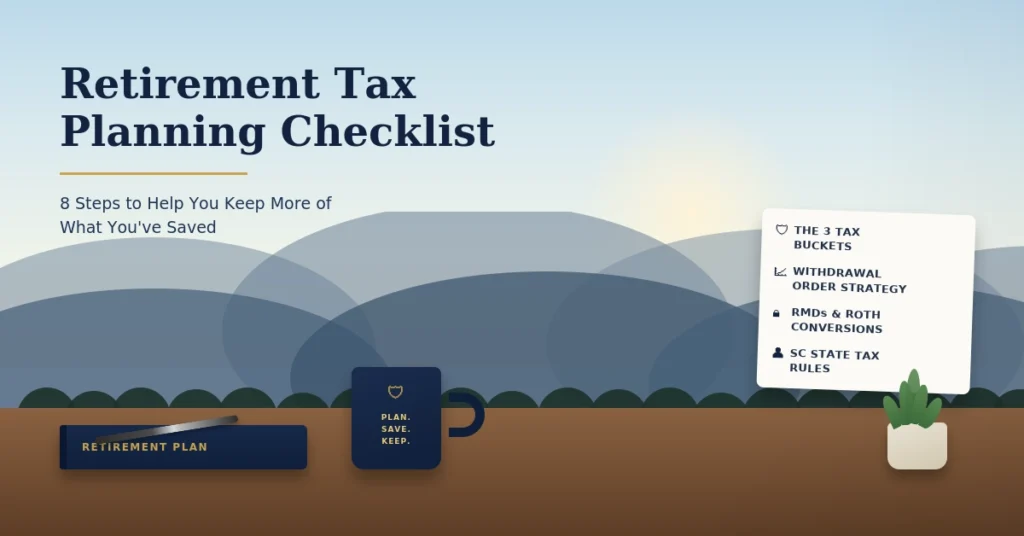
How to Keep More of What You’ve Saved
Most retirement planning conversations focus on saving and investing — but taxes are often the single largest expense retirees face, and one of the most overlooked. A thoughtful tax planning checklist can mean the difference between a retirement income plan that’s efficient and one that quietly loses thousands of dollars a year to avoidable taxes.
Here’s a practical checklist South Carolina retirees can use to evaluate their own tax exposure heading into retirement.
1. Know Your Three Tax “Buckets”
Most retirement savings fall into one of three tax categories, and understanding the mix matters as much as the total balance:
| Bucket | Examples | Tax Treatment |
|---|---|---|
| Taxable Now | Savings accounts, CDs, brokerage accounts | Taxed annually as earned |
| Tax-Deferred | Traditional IRA, 401(k), most annuities | Taxed on withdrawal |
| Tax-Free | Roth IRA, cash value life insurance | Never taxed on qualified withdrawals |
2. Plan Your Withdrawal Order Strategically
The order you draw from these accounts can significantly change your lifetime tax bill. A common approach is drawing from taxable accounts first, tax-deferred accounts next, and tax-free accounts last but the right order depends on your full income picture, including Social Security and any pension income.
☐ Do you have a specific withdrawal sequence, or are you drawing reactively as needs arise?
3. Understand How Social Security Gets Taxed
Up to 85% of Social Security benefits can become taxable depending on your combined income — a detail many retirees don’t realize until it affects their tax bill. Managing other income sources carefully can help minimize how much of your Social Security ends up taxed.
☐ Have you calculated how your other income affects the taxability of your Social Security benefit?
4. Check Required Minimum Distributions (RMDs)
Traditional IRAs and 401(k)s require minimum distributions starting at a certain age, whether or not you need the income. Missing an RMD deadline can trigger a steep penalty.
☐ Do you know your RMD start age and how it fits into your broader income plan?
5. Consider Roth Conversions Before RMD Age
Converting a portion of a traditional IRA to a Roth IRA during lower-income years (often early retirement, before RMDs begin) can reduce future taxable income — but the conversion itself is taxable in the year it happens, so timing and amount matter.
☐ Have you evaluated whether partial Roth conversions make sense for your situation?
6. Use Tax-Deferred Growth Strategically
Annuities grow tax-deferred, meaning you don’t pay taxes on the growth until you withdraw it — which can be a useful tool for controlling when income (and the associated tax) hits your return.
☐ Are you using tax-deferred growth tools where they make sense in your plan?
7. Don’t Forget State Taxes
South Carolina offers a retirement income deduction for many retirees, but the specifics depend on your age and income sources. State-level tax rules are easy to overlook when most retirement tax advice focuses only on federal taxes.
☐ Have you factored South Carolina’s specific retirement tax rules into your plan?
8. Revisit the Plan Every Year
Tax laws change, income sources shift, and RMD rules evolve. A tax-efficient plan built five years ago may no longer be optimized for today’s rules.
☐ Has your tax strategy been reviewed in the last 12 months?
Turning This Checklist Into a Real Strategy
Working through this list often reveals gaps that are easy to miss without a coordinated plan — particularly around Social Security taxation and RMD timing. At PAG Advisory Group, we help South Carolina retirees build tax-efficient income strategies using annuities and life insurance, designed around all three tax buckets rather than just one.
Want help turning this checklist into an actual plan? Schedule a free tax strategy review and find out where your retirement income plan could be more tax-efficient.