


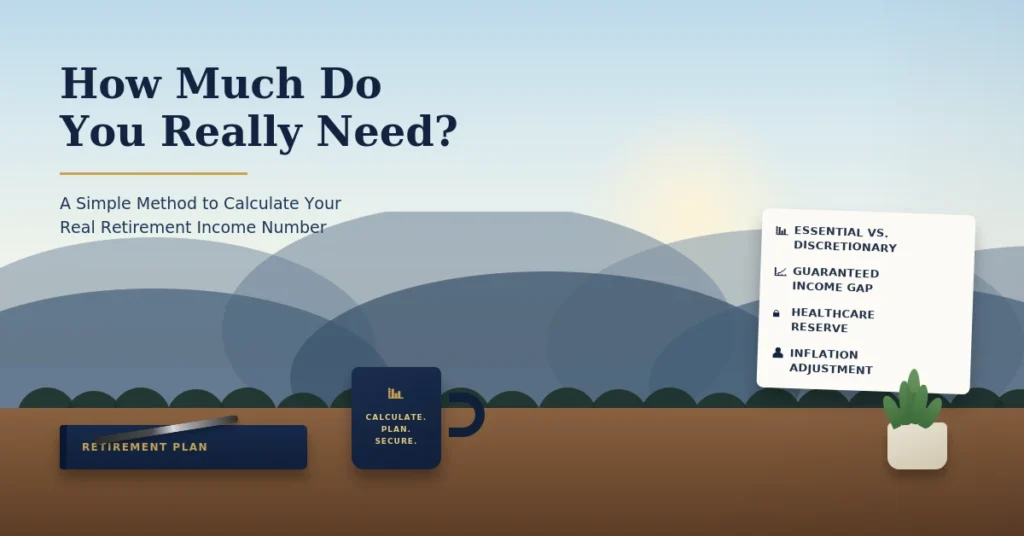
One of the most common questions retirees and pre-retirees ask is deceptively simple: how much income will I actually need in retirement? Guessing or relying on a generic “70-80% of your current income” rule often leads to either under-saving or over-saving, when a more precise, personal calculation gets you a far more useful number.
Here’s a practical, step-by-step way to calculate your real retirement income need.
Why the “Rule of Thumb” Falls Short
The commonly cited advice that you’ll need 70-80% of your pre-retirement income is a reasonable starting estimate, but it ignores your actual spending patterns. Someone who plans to travel extensively in retirement may need more than their working income. Someone whose mortgage will be paid off and whose kids are grown may need considerably less. A generic percentage can’t capture that.
Step 1: Separate Essential and Discretionary Expenses
Start by dividing your expected retirement spending into two categories:
- Essential expenses — housing, utilities, groceries, healthcare, insurance premiums. These need to be covered by guaranteed income sources, since they don’t flex if the market has a bad year.
- Discretionary expenses — travel, dining out, hobbies, gifts. These have more flexibility and can reasonably be covered by a mix of guaranteed and market-based income.
This distinction matters because it tells you not just how much income you need, but what kind of income needs to cover it.
Step 2: Add Up Your Guaranteed Income Sources
List every source of income that will continue regardless of market performance:
- Social Security (at your planned claiming age)
- Pension income, if applicable
- Any existing annuity income
Compare this total to your essential expenses from Step 1. The gap between them if any is what a strategy like a personal pension or income annuity is often designed to fill.
Step 3: Account for Healthcare and Long-Term Care
Healthcare costs tend to rise faster than general inflation, and this is one of the most commonly underestimated expenses in retirement planning. Build in a realistic, dedicated line item for healthcare premiums, out-of-pocket costs, and the possibility of long-term care rather than folding it into a general “expenses” catch-all.
Step 4: Build in an Inflation Assumption
As covered in our recent inflation guide, a dollar today won’t buy the same amount in 15-20 years. When calculating your number, assume expenses will rise 2-3% annually rather than assuming your current budget stays flat for the rest of your retirement.
Step 5: Stress-Test the Number
Once you have a target monthly or annual income figure, ask:
- Does this number hold up if I live to 90 or 95, not just my current life expectancy estimate?
- What happens to this plan if there’s a market downturn in the first few years of retirement?
- Have I accounted for one spouse potentially living significantly longer than the other?
A Simple Framework to Start With
| Category | Monthly Amount | Covered By |
|---|---|---|
| Essential Expenses | $______ | Guaranteed income only (Social Security, pension, annuities) |
| Discretionary Expenses | $______ | Guaranteed + market-based income |
| Healthcare/LTC Reserve | $______ | Dedicated savings or insurance-based planning |
| Total Monthly Need | $______ |
Filling in this simple table even roughly gives you a far more useful planning number than a generic percentage rule.
Turn Your Number Into a Real Plan
At PAG Advisory Group, we help South Carolina retirees calculate a realistic retirement income number and then build a guaranteed-income strategy to actually fund it using fixed and fixed indexed annuities, Social Security timing, and tax-efficient planning.
Not sure what your real retirement income number is? Schedule a free retirement income review and get a clear, personalized calculation not a generic rule of thumb.