



Changing jobs, retiring, or simply consolidating old retirement accounts often raises the same question: what do I do with my old 401(k) or IRA? An IRA rollover is usually the right move — but getting the process wrong can quietly cost you in ways that aren’t obvious until tax season, from surprise withholding to a permanently smaller nest egg.
For South Carolina retirees and pre-retirees juggling multiple old employer plans, understanding IRA rollover rules before making a move can save thousands of dollars and a lot of stress.
What Is an IRA Rollover?
An IRA rollover is the process of moving retirement funds — typically from a 401(k), 403(b), or another employer-sponsored plan — into an Individual Retirement Account (IRA), without triggering immediate taxes or early-withdrawal penalties, as long as it’s done correctly.
Common situations that call for a rollover include:
- Leaving a job and no longer contributing to an employer’s 401(k)
- Retiring and wanting more control over investment and income options
- Consolidating several old retirement accounts into one place
- Seeking access to guaranteed income products, like annuities, that many 401(k) plans don’t offer
A direct rollover skips the 20% withholding and the 60-day deadline entirely for almost everyone, it’s the safer way to move retirement funds. If you’re not sure which type applies to your situation, that’s exactly what a quick, no-obligation review is for.
Direct Rollover vs. Indirect Rollover
This distinction matters more than most people realize:
Direct Rollover: Funds move directly from your old plan administrator to your new IRA custodian. You never personally receive the money. This is the safest, simplest method and avoids tax withholding entirely.
Indirect Rollover: The check is made out to you personally, and you have 60 days to deposit the full amount into a new IRA. If you miss that window — or don’t redeposit the full amount, including the 20% typically withheld for taxes — the IRS treats it as a taxable distribution, and if you’re under 59½, a 10% early withdrawal penalty may apply on top of that.
The safest move for most people: always request a direct rollover whenever possible.
Direct vs. Indirect Rollover — At a Glance
A quick side-by-side comparison to help you understand which option applies to your situation.
| Direct Rollover | Indirect Rollover | |
|---|---|---|
| Who receives the funds | New IRA custodian (never you) | You, personally, via check |
| Tax withholding | ✓ None | 20% automatically withheld |
| Time limit | ✓ No deadline | Must redeposit within 60 days |
| Risk of penalty | ✓ None | 10% early withdrawal penalty if under 59½ and deadline missed |
| Paperwork complexity | Low | Higher — must track and redeposit full amount, including withheld portion |
| Best for | Nearly everyone | Rare cases requiring short-term access to funds |
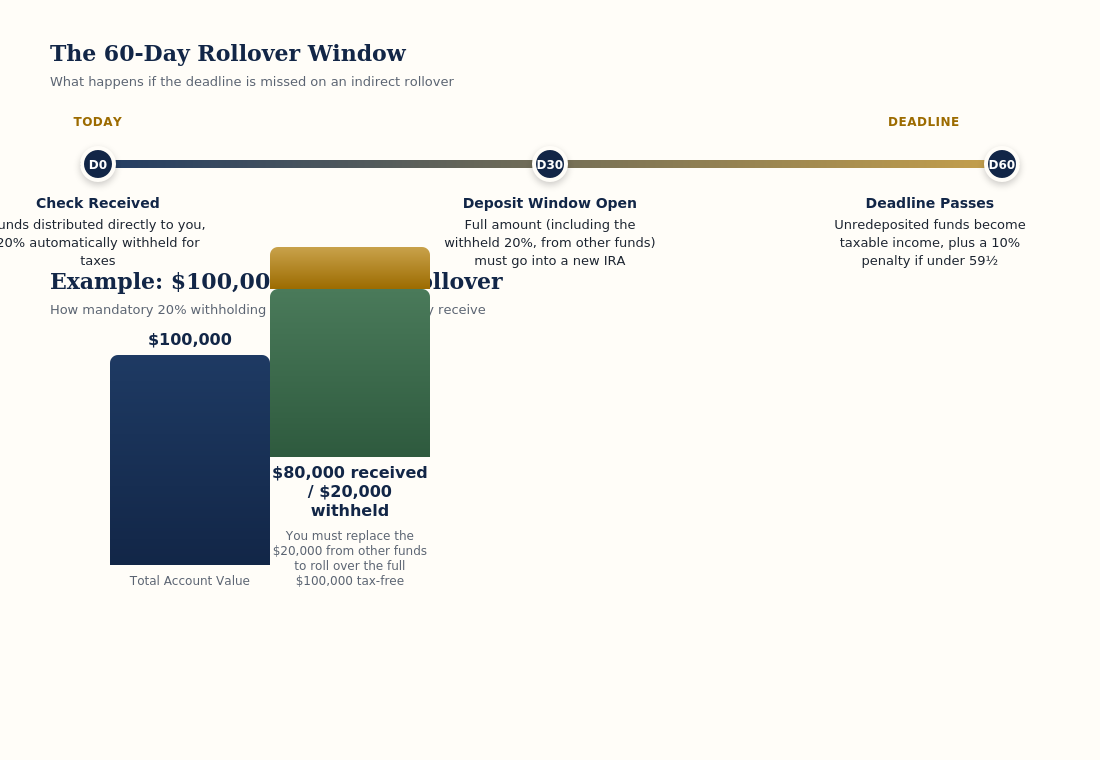
The 60-day window and what happen if it’s missed. Right: how mandatory 20% withholding affects a $100,000 indirect rollover.
Common IRA Rollover Mistakes to Avoid
Small missteps in the rollover process can create costly, avoidable tax consequences.
| Mistake | What It Can Cost You | How to Avoid It |
|---|---|---|
| Missing the 60-day window | Full amount becomes taxable income for the year | Choose a direct rollover so there’s no deadline to track |
| Not accounting for the 20% withholding | Must cover the withheld amount out-of-pocket to roll over the full balance tax-free | Request a direct, trustee-to-trustee transfer instead |
| Mixing pre-tax and after-tax dollars | Confusing tax reporting, possible double taxation | Keep pre-tax and after-tax funds in separate accounts |
| Exceeding the once-a-year IRA-to-IRA rollover limit | Extra rollover counts as taxable income | Track rollover dates carefully, or use direct transfers (not subject to this limit) |
| Overlooking employer stock | Loss of favorable Net Unrealized Appreciation (NUA) tax treatment | Review employer stock holdings with an advisor before rolling over |
Why a Rollover Can Be a Good Opportunity — Not Just a Formality
Beyond avoiding mistakes, a rollover is also a natural checkpoint to reassess your retirement income strategy. Many employer 401(k) plans offer a limited menu of mutual funds with no guaranteed income options. Rolling funds into an IRA can open the door to:
- A broader range of investment choices
- Fixed indexed annuities or other guaranteed income products
- A consolidated, easier-to-manage retirement picture
- A tax-efficient withdrawal strategy built around your full financial picture, not just one account in isolation
Work With a Fiduciary Before You Move Anything
Because rollovers involve real tax consequences and irreversible decisions, it’s worth working with a fiduciary consultant — someone legally obligated to act in your best interest, not just recommend whatever pays the highest commission.
At PAG Advisory Group, we help South Carolina retirees and pre-retirees evaluate whether a rollover makes sense, walk through the direct-rollover paperwork correctly, and build a retirement income strategy around the consolidated funds — with zero pressure and zero obligation.
Considering a 401(k) or IRA rollover? Schedule a free retirement review with William Garland and get a clear, unbiased answer on the right next step for your retirement savings.